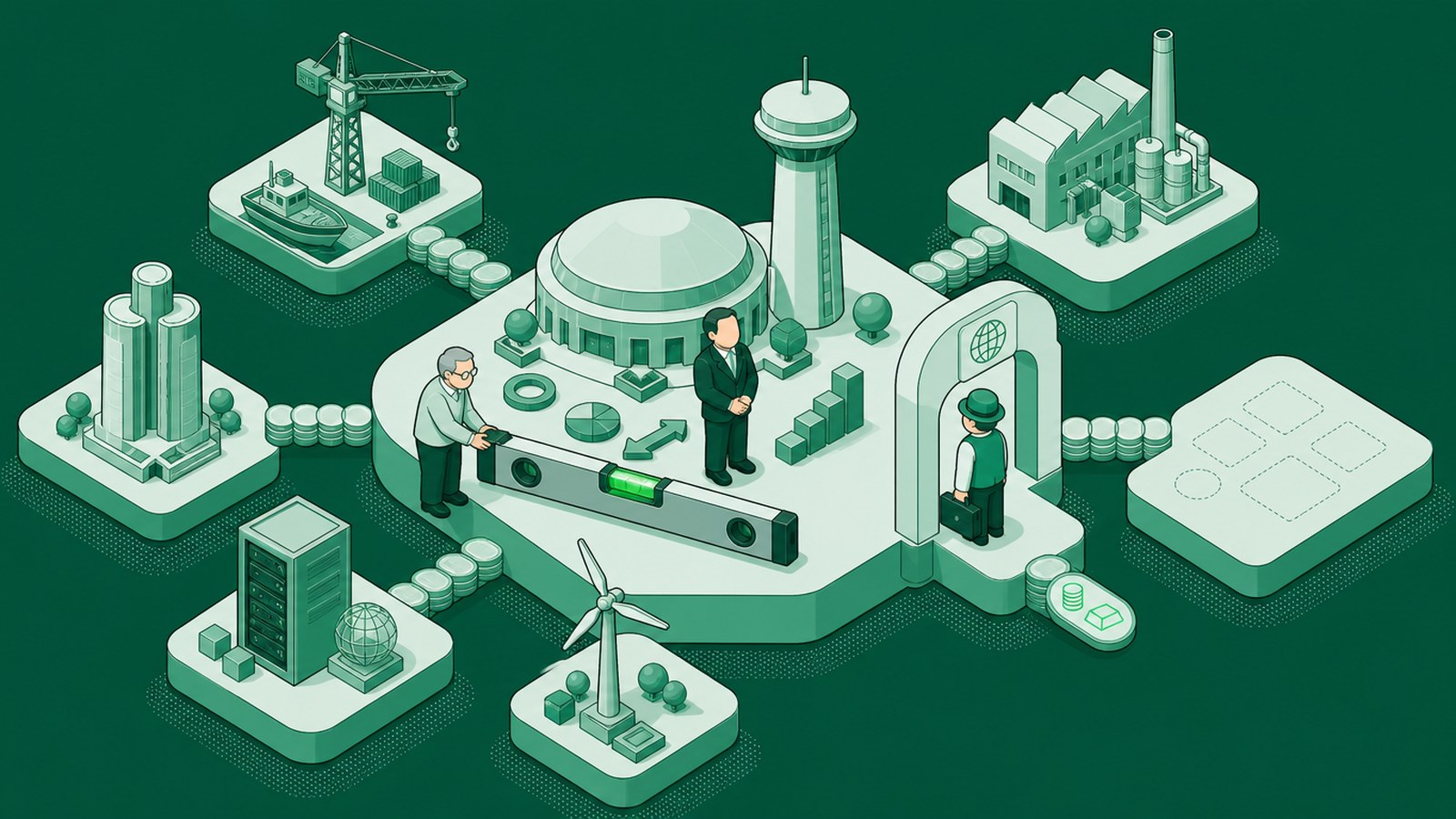
With this article the series turns from the present to the future, and no bet the emirate is placing on that future is larger, or more revealing, than its wager on artificial intelligence. Abu Dhabi has decided that the next phase of its economy will be built on compute: on data centres, chips, models and the physical infrastructure of machine intelligence. It is spending on a scale that puts it among a small handful of states genuinely trying to matter in this field. I want to assess that wager honestly, which means giving full weight both to how serious and well-resourced it is, and to a dependency at its heart that the emirate, for all its capital, does not control and cannot simply buy its way out of.
I should say at the outset that this is the most fast-moving subject in the series, and the one where figures date quickest. The programme has moved substantially through 2025 and 2026, and I will state the position I am relying on and its date rather than pretend to a permanence the field does not have. The direction of travel, however, is unmistakable, and the strategic logic is stable even as the specifics change month to month.
The scale of the wager
The centre of the strategy is G42, the Abu Dhabi technology group incorporated in 2018 and chaired by Sheikh Tahnoon bin Zayed Al Nahyan, who is also the UAE’s National Security Advisor. That the national AI champion sits so close to the security apparatus is itself a signal that this is treated as a matter of national strategy, not merely commerce. Around G42 sits a wider architecture: MGX, an investment vehicle reported to be built for roughly 100 billion US dollars of artificial-intelligence and infrastructure investment, and the Technology Innovation Institute, whose Falcon family of open models gave the emirate an early presence in frontier research. Taken together, this is not a dabbling. It is a coordinated, sovereign-scale attempt to build a position across chips, compute, capital and models at once.
The physical centrepiece is the compute build itself. In May 2025 the UAE and the United States announced an AI Acceleration Partnership, and from it came plans for a data-centre campus in Abu Dhabi of around five gigawatts, spanning roughly ten square miles, described as the largest such deployment outside the United States. Within it sits Stargate UAE, a one-gigawatt cluster being built by G42 and operated with OpenAI and Oracle, alongside Nvidia, Cisco and SoftBank, with a first 200-megawatt phase expected to come online during 2026. The ambition is to make Abu Dhabi a regional hub of machine intelligence, close enough to serve a very large share of the world’s population with low-latency compute.
Behind this lies a genuine and unusual structural advantage, and I want to give it its due before I turn to the constraints. Artificial intelligence at this scale is, physically, an energy problem: gigawatts of power to run and cool the chips. Abu Dhabi has abundant, low-cost energy, the sovereign capital to finance construction at scale, and, as the previous articles described, the clean-power build, including nuclear baseload, to feed it. Few places on earth can combine cheap power, patient capital and the political will to build at gigawatt scale in the same jurisdiction. On the supply side of compute, the emirate holds cards that most aspiring AI nations simply do not.
The dependency at the centre of it all
Now the constraint, and it is the whole game. None of this works without advanced chips, and those chips are American, controlled by American export policy, and available to Abu Dhabi only with Washington’s permission. This single fact shapes everything. In April 2024, Microsoft invested 1.5 billion dollars in G42 for a minority stake, and the price of that partnership was G42 divesting from Chinese technology, including Huawei equipment, and aligning itself with the American technology stack. That was not an incidental commercial term. It was the moment Abu Dhabi chose a side in the defining technological rivalry of the age, because access to the chips required it.
What followed traced the same logic. In late November 2025 the United States approved advanced chip exports allowing G42 to acquire up to 35,000 of Nvidia’s latest systems or their equivalent, with a wider arrangement permitting the UAE to import up to 500,000 advanced chips a year, of which G42 would take a share. The first batch arrived in the country in May 2026. In July 2026 the US Commerce Department went further, reclassifying the UAE into its highest export-control tier, a status that treats Emirati compute as part of American strategy rather than a risk to be managed transaction by transaction. Each of these was a genuine win for the emirate. Each was also a reminder that the tap can be opened, and could in principle be narrowed, by a decision taken in Washington rather than Abu Dhabi.
The chips are American, and available to Abu Dhabi only with Washington’s permission. That single fact shapes everything else about the strategy, including who ultimately owns the champion building it.
The clearest evidence of how deep this dependency runs came in September 2026, when it was reported that G42 was exploring the sale of a majority stake to American investors and a possible reincorporation in the United States, in order to secure permanent rather than periodically renewed access to the most advanced chips. I present this as a reported development rather than a settled fact, and its final shape was not known at the time of writing. But the direction is telling. To guarantee the supply on which its national AI champion depends, Abu Dhabi appears willing to consider letting that champion become, in ownership terms, substantially American. That is a remarkable thing for a sovereign strategy to contemplate, and it measures the price of the dependency more honestly than any official statement could.
Reading the wager fairly
How should an investor or a policy reader weigh all this? I would resist both of the easy conclusions. The breathless version treats Abu Dhabi as an inevitable AI superpower on the strength of its capital and its energy. The dismissive version treats the whole effort as a vanity project that will never escape American control. Neither is right, and the truth sits in the tension between the emirate’s real advantages and its real dependency.
On the credit side, the strategy is coherent and unusually well-resourced. Abu Dhabi has correctly identified that compute infrastructure, not model research alone, is where a capital-and-energy-rich state can build durable position, and it has moved decisively to occupy that ground. If artificial intelligence becomes the general-purpose technology its proponents expect, owning a large share of the region’s compute, and equity in the firms at the frontier through vehicles like MGX, could prove one of the better uses to which the emirate ever put its sovereign wealth. The bet is intelligent, not merely large.
The equity dimension deserves separate mention, because it is a distinct wager layered on top of the infrastructure one. Through MGX and related vehicles, Abu Dhabi has been taking positions not only in data centres but in the frontier companies themselves, participating in the very large financing rounds of leading model developers. If those companies capture the value their valuations imply, the emirate will own a share of the frontier rather than merely hosting it, which is a more ambitious and more leveraged bet than building compute alone. It is also a riskier one: frontier valuations are extraordinary and unproven, and a sovereign fund writing very large cheques into them is exposed to a correction as much as to a windfall. The strategy spans the full stack, from chips to compute to equity, and the risk spans it too.
On the debit side, the dependency is not a footnote but a structural feature, and it will persist. Abu Dhabi can supply the power, the capital, the land and the cooling, but it cannot yet make the chips, and the entity that can is subject to the export policy of a single foreign government and to the shifting state of that government’s rivalry with China. The emirate has managed this dependency with genuine skill, choosing its side clearly, offering security assurances, and making itself useful enough to Washington that the chips have flowed. But managing a dependency is not the same as removing it, and a strategy this important resting on a foundation this exogenous carries a risk that no amount of domestic execution can fully hedge.
There is a second, quieter dependency worth naming, because it is easy to miss beneath the geopolitics. Building the compute is one thing; using it productively is another. A gigawatt of chips creates economic value only if there is demand to consume it, talent to build on it, and applications that turn raw compute into output. Some of the announced capacity is contracted to serve international hyperscalers, which is real external income. But the broader ambition, that this infrastructure will seed a domestic intelligence economy of applications, research and skilled work, depends on factors, including human capital, that the next article examines and that hardware alone cannot supply. Compute is necessary. It is not sufficient.
A further constraint links this article to the one on energy later in this arc. Compute at gigawatt scale is, physically, an enormous and continuous draw on electricity, and on water for cooling, in a hot desert where both are already under pressure. The emirate’s cheap, abundant power is a genuine advantage, but the artificial-intelligence build competes for the same clean electrons that the decarbonisation effort is trying to free up, and it does so on a steeply rising demand curve. The intelligence economy and the energy transition are therefore not independent wagers; they draw on the same finite physical base, and the more successful the first becomes, the heavier the load it places on the second. Success in one dimension quietly raises the difficulty in another.
A serious bet with an honest asterisk
My assessment is that this is one of the most serious national technology strategies being pursued anywhere, and that it rests on a dependency the emirate cannot resolve on its own terms. Both statements are true, and holding them together is the whole of an honest reading. Abu Dhabi has done almost everything within its power well: it has committed capital at scale, secured the energy, chosen its geopolitical side deliberately, and positioned itself as a trusted partner rather than a risk to be contained. The result is a genuine, fast-growing position in the physical infrastructure of artificial intelligence, achieved in a remarkably short time.
And yet the thing it most needs, the advanced chip, remains outside its control, and the lengths it now appears willing to go to in order to guarantee supply, up to and including ceding majority ownership of its champion, show how binding that constraint is. The intelligence economy may well become one of the pillars on which the post-oil emirate stands. But it will be a pillar built, for the foreseeable future, on a foundation that Abu Dhabi rents from Washington rather than owns outright. That is not a reason for the emirate not to make the bet; given its advantages, the bet is rational. It is a reason for anyone assessing the bet to keep the asterisk firmly in view. The ambition is real, the capital is real, and the dependency is real, and the third of those does not cancel the first two so much as define the terms on which they will be tested.